The Iraqi dinar is the official currency of Iraq. The nation stays largely isolated from global financial markets. The nation has no real sovereign credit, there is small need for its money which stays thinly traded. All Iraqi property, including its money are viewed as currently being a very great financial risk. The Iraqi dinar value, or the Iraqi dinar exchange rate, is effectively determined through the central bank through it's US currency auctions. The Iraq dinar was initially launched in 1932 when Iraq grew to become independent from British rule. The dinar changed the Indian rupee that had been launched by the British following winning control of Iraq from Turkey in WWI. The Iraqi dinar continues to be a managed or controlled currency throughout its existence.
Initially, when it was first placed into circulation, the Iraqi dinar was pegged towards the British pound. By 1959 Iraqi nationwide wealth had proved to be more and more coupled with oil. Oil was priced and traded globally in terms from the US currency, so the Iraqi currency peg was altered within the path of the US dollar and stays so today. After the initial US Gulf Struggle and the imposition of UN financial sanctions, financial conditions inside Iraq worsened sharply. By 1993, inflation had rocketed to an amazing yearly rate of more than 1000 percent, unemployment was at a massive fifty percent and also the Iraqi dinar exchange rate dropped considerably. Throughout 1994, it required about 2,500 dinars to buy one US dollar. To help the dinar, numerous measures had been launched in 1996 such as new regulations allowing Iraqi citizens to own overseas money financial institution accounts.
Following the 2nd Gulf War, new preparations had been created to take effect on 15 October 2003 to issue a new Iraqi dinar and to manage the Iraqi dinar exchange rate. Since those new arrangements have been launched, the Iraqi dinar value has steadily increased. The current exchange rate is 1,170 dinars for 1 US dollar. Figures published through the Central Intelligence Agency (CIA) in its World Fact Book display the number of Iraqi dinars needed to purchase 1 US dollar was at 1,475 dinars in 2005, 1,466 in 2006, 1,255 in 2007, 1,176 in 2008 and 1,170 in 2009. All indicators point to the presently prevailing exchange rate gradually increasing in the not too distant future.
Iraq just lately quantified its confirmed raw oil reserves at 143 billion barrels, in comparison with Saudi Arabia with 265 billion barrels of confirmed reserves. The nice part about these reserves are that they are effortlessly accessible and as a result the oil is cheap to produce. Roughly 95% of all Iraqi export value is derived from crude oil.
In the long run, as political balance returns to Iraq, its financial programs gains efficiencies and its citizens capture the full value of the national crude oil wealth, the Iraqi dinar value might be anticipated to strengthen considerably over its current trading valuations.
There are other sources and articles on the subject of Iraqi dinar value listed below.


Showing posts with label buy iraqi dinar. Show all posts
Showing posts with label buy iraqi dinar. Show all posts
Sunday, December 26, 2010


Sunday, November 22, 2009
Iraqi Dinar Value - The Dollar While Weak Is Still King, Even In Iraq
Interesting article on the supposed fall of the dollar and the possible replacement by other currencies as the world currency of choice. The Iraqi Dinar could be worth even more than expected.
Globally, the Greenback Remains King
The Wall Street Journal
October 29, 2009
The U.S. dollar, once universally accepted as the world's strongest currency, has been trounced in recent months by everything from the euro to the Brazilian real to the South Korean won. But in the back-alley markets where business is done in many of the world's developing economies, the dollar still reigns.
In jewelry stores in Vietnam, taxicabs in Venezuela and outdoor markets in Nigeria, black-market money-changers say the dollar is still the currency of choice, even though its value has fallen in some cases.
"The U.S. dollar is losing value, but not here in Vietnam," said Vu Manh Quynh, an auto trader who regularly exchanges dong for dollars in the winding streets of Hanoi's Old Quarter. "Vietnamese people still keep U.S. dollars and gold." While the U.S. dollar fetches 17,858 dong on the official rates, the black market rate is closer to 18,600. Hai Duong, a currency trader, said he had 20 or more customers buying U.S. dollars on a recent Wednesday, compared with two customers buying euros.
While their true size is unknown, black markets in currencies are key to greasing the wheels of commerce in countries that have tight currency controls. They provide residents and companies with protection against inflation or a possible devaluation of the local currency, and give companies a source of dollars with which to buy and sell goods abroad. In most countries, the markets are illegal, while in others they are tacitly condoned.
"Typically, dollars are king in the black markets of the world," says Kenneth Rogoff, professor of economics at Harvard University and former chief economist at the International Monetary Fund.
Prof. Rogoff estimates that as much as 75% of U.S. notes in circulation, or more than $600 billion, are held outside the U.S. Most of that is likely in what he calls the underground economy, where transactions are made beyond the oversight of government -- much of which is juiced by the black market.
"This money is not in cash registers, it's not in bank vaults," Prof. Rogoff says.
In the world's official foreign-exchange markets, where turnover totals about $3 trillion each day, according to the Bank for International Settlements, the dollar's luster has diminished. The dollar, for example, has fallen about 6% against the euro this year. The dollar has dropped about 15% against a basket of currencies since early March.
The ballooning U.S. deficit and a move by investors away from the haven of the dollar as world economies recover have sparked worries that the currency may be headed for a years-long swoon. It also has opened the door for renewed questioning of the dollar's future as the world's reserve currency.
For Venezuelans, where the black market plays a crucial role in the financial system, the dollar has retained its status. Residents seeking protection against inflation or a devaluation of the bolivar turn to currency traders. Large companies that need dollars for operations abroad also visit the unregulated market.
View Full Image
Justin Mott for The Wall Street Journal
."Having dollars is like a barricade," says Arnaldo Morales, a cabby who moonlights as a currency trader, buying dollars from travelers as they enter the country, then selling them to Venezuelans.
Mr. Morales says he has been trading dollars since 2003, when President Hugo Chávez imposed a currency peg. Residents can purchase only $2,500 for travel abroad each year at the official rate of 2.15 bolivars.
The economy has become so heavily dependent on the so-called parallel exchange rate for greenbacks that the government was recently forced to intervene after the dollar traded as high as seven bolivars in August. The government is flooding the domestic market with dollars by selling bonds to locals who then trade them abroad for U.S. currency.
"The dollar will always be strong," says Andrea Martinez, a trader who dismissed as temporary the recent decline in the black-market rate. Ms. Martinez operates inside a tiny, nondescript mall where shotgun-carrying private-security guards wearing bulletproof vests watch over rows of pawn shops that serve as a front for dollar traders. On a good day, she says, she still sells as much as $5,000.
In Nigeria, sub-Sahara Africa's second-largest economy, currency traders still deal predominantly in American currency. The black-market traders even have their own trade group, the Association of Bureaux de Change Operators of Nigeria.
"The dollar still has dominance in Nigeria," said Alhaji Farouk Suleman, the president of the group. "The exchange rate might not be good, but you know what you're dealing with and that you can use the dollar anywhere you go. I don't see any real shift towards the pound or euro."
The Nigerian naira, after plummeting late last year and earlier this year, has stabilized against the dollar, thanks to renewed confidence after harsh banking reforms undertaken by a new central bank governor. The dollar was fetching 183 naira in the spring, but now buys about 153 naira.
But the dollar's descent against the world's biggest currencies hasn't gone unnoticed.
On the streets of Mumbai, illegal currency traders that swap wads of cash from bags behind their shops in the bustling back alleys of Colaba, a neighborhood popular with tourists, say business has been slow recently. The dollar's decline has sellers waiting for a rebound and buyers waiting for a better deal.
"Business is way down," says one trader, spitting a stream of red betel-nut juice in the alley behind his shop and wiping his moustache. "People still want to wait." The dollar buys 47 rupees at licensed currency-trading companies and 46.70 rupees on the black market.
And at the Super Rich currency exchange near one of Bangkok's busiest downtown thoroughfares, Thaweesak Kanchanakorn says he and his girlfriend are planning to vacation in the U.S., and that he thought it might be a good idea to invest in dollars now, because they're "cheap." In the long run, "I don't think the U.S. dollar will still be a major currency for reserves anymore," he said. China's yuan "will take its place."
For now, those seeking to exchange bolivars or dong are choosing the U.S. dollar, if only because it remains the most recognizable of the world's currencies.
In Iraq, where legal currency exchanges have become common, the U.S. presence since 2003 has kept up demand for the dollar at the expense of the euro.
Ali Mohammed of the Al Nasir currency-exchange company said that although the world market value of the euro has risen, it is difficult to exchange in Baghdad. And the dollar likely will be Iraq's unofficial second currency for some time to come. The dollar fetched about 1,190 dinars in September, according to central bank figures, little changed from 1,220 dinars at the beginning of 2008.
"It's the only thing used, besides the Iraqi dinar, for commercial business and trade," he said. "As long as it stays pretty stable, we don't mind this."
Carlos Denis, who trades in the Venezuelan mall alongside Ms. Martinez, insists that the dollar is still the only currency that matters. "Take out a dollar bill in the remotest place in world and people will recognize it," he said.
-- Eric Bellman in India, Gina Chon in Iraq and Wilawan Watcharasakwet
in Thailand contributed
to this article.
Globally, the Greenback Remains King
The Wall Street Journal
October 29, 2009
The U.S. dollar, once universally accepted as the world's strongest currency, has been trounced in recent months by everything from the euro to the Brazilian real to the South Korean won. But in the back-alley markets where business is done in many of the world's developing economies, the dollar still reigns.
In jewelry stores in Vietnam, taxicabs in Venezuela and outdoor markets in Nigeria, black-market money-changers say the dollar is still the currency of choice, even though its value has fallen in some cases.
"The U.S. dollar is losing value, but not here in Vietnam," said Vu Manh Quynh, an auto trader who regularly exchanges dong for dollars in the winding streets of Hanoi's Old Quarter. "Vietnamese people still keep U.S. dollars and gold." While the U.S. dollar fetches 17,858 dong on the official rates, the black market rate is closer to 18,600. Hai Duong, a currency trader, said he had 20 or more customers buying U.S. dollars on a recent Wednesday, compared with two customers buying euros.
While their true size is unknown, black markets in currencies are key to greasing the wheels of commerce in countries that have tight currency controls. They provide residents and companies with protection against inflation or a possible devaluation of the local currency, and give companies a source of dollars with which to buy and sell goods abroad. In most countries, the markets are illegal, while in others they are tacitly condoned.
"Typically, dollars are king in the black markets of the world," says Kenneth Rogoff, professor of economics at Harvard University and former chief economist at the International Monetary Fund.
Prof. Rogoff estimates that as much as 75% of U.S. notes in circulation, or more than $600 billion, are held outside the U.S. Most of that is likely in what he calls the underground economy, where transactions are made beyond the oversight of government -- much of which is juiced by the black market.
"This money is not in cash registers, it's not in bank vaults," Prof. Rogoff says.
In the world's official foreign-exchange markets, where turnover totals about $3 trillion each day, according to the Bank for International Settlements, the dollar's luster has diminished. The dollar, for example, has fallen about 6% against the euro this year. The dollar has dropped about 15% against a basket of currencies since early March.
The ballooning U.S. deficit and a move by investors away from the haven of the dollar as world economies recover have sparked worries that the currency may be headed for a years-long swoon. It also has opened the door for renewed questioning of the dollar's future as the world's reserve currency.
For Venezuelans, where the black market plays a crucial role in the financial system, the dollar has retained its status. Residents seeking protection against inflation or a devaluation of the bolivar turn to currency traders. Large companies that need dollars for operations abroad also visit the unregulated market.
View Full Image
Justin Mott for The Wall Street Journal
."Having dollars is like a barricade," says Arnaldo Morales, a cabby who moonlights as a currency trader, buying dollars from travelers as they enter the country, then selling them to Venezuelans.
Mr. Morales says he has been trading dollars since 2003, when President Hugo Chávez imposed a currency peg. Residents can purchase only $2,500 for travel abroad each year at the official rate of 2.15 bolivars.
The economy has become so heavily dependent on the so-called parallel exchange rate for greenbacks that the government was recently forced to intervene after the dollar traded as high as seven bolivars in August. The government is flooding the domestic market with dollars by selling bonds to locals who then trade them abroad for U.S. currency.
"The dollar will always be strong," says Andrea Martinez, a trader who dismissed as temporary the recent decline in the black-market rate. Ms. Martinez operates inside a tiny, nondescript mall where shotgun-carrying private-security guards wearing bulletproof vests watch over rows of pawn shops that serve as a front for dollar traders. On a good day, she says, she still sells as much as $5,000.
In Nigeria, sub-Sahara Africa's second-largest economy, currency traders still deal predominantly in American currency. The black-market traders even have their own trade group, the Association of Bureaux de Change Operators of Nigeria.
"The dollar still has dominance in Nigeria," said Alhaji Farouk Suleman, the president of the group. "The exchange rate might not be good, but you know what you're dealing with and that you can use the dollar anywhere you go. I don't see any real shift towards the pound or euro."
The Nigerian naira, after plummeting late last year and earlier this year, has stabilized against the dollar, thanks to renewed confidence after harsh banking reforms undertaken by a new central bank governor. The dollar was fetching 183 naira in the spring, but now buys about 153 naira.
But the dollar's descent against the world's biggest currencies hasn't gone unnoticed.
On the streets of Mumbai, illegal currency traders that swap wads of cash from bags behind their shops in the bustling back alleys of Colaba, a neighborhood popular with tourists, say business has been slow recently. The dollar's decline has sellers waiting for a rebound and buyers waiting for a better deal.
"Business is way down," says one trader, spitting a stream of red betel-nut juice in the alley behind his shop and wiping his moustache. "People still want to wait." The dollar buys 47 rupees at licensed currency-trading companies and 46.70 rupees on the black market.
And at the Super Rich currency exchange near one of Bangkok's busiest downtown thoroughfares, Thaweesak Kanchanakorn says he and his girlfriend are planning to vacation in the U.S., and that he thought it might be a good idea to invest in dollars now, because they're "cheap." In the long run, "I don't think the U.S. dollar will still be a major currency for reserves anymore," he said. China's yuan "will take its place."
For now, those seeking to exchange bolivars or dong are choosing the U.S. dollar, if only because it remains the most recognizable of the world's currencies.
In Iraq, where legal currency exchanges have become common, the U.S. presence since 2003 has kept up demand for the dollar at the expense of the euro.
Ali Mohammed of the Al Nasir currency-exchange company said that although the world market value of the euro has risen, it is difficult to exchange in Baghdad. And the dollar likely will be Iraq's unofficial second currency for some time to come. The dollar fetched about 1,190 dinars in September, according to central bank figures, little changed from 1,220 dinars at the beginning of 2008.
"It's the only thing used, besides the Iraqi dinar, for commercial business and trade," he said. "As long as it stays pretty stable, we don't mind this."
Carlos Denis, who trades in the Venezuelan mall alongside Ms. Martinez, insists that the dollar is still the only currency that matters. "Take out a dollar bill in the remotest place in world and people will recognize it," he said.
-- Eric Bellman in India, Gina Chon in Iraq and Wilawan Watcharasakwet
in Thailand contributed
to this article.
Friday, August 21, 2009
Buy Iraqi Dinar - Iraq: Arrests made in ministry truck bombings
Iraq: Arrests made in ministry truck bombings
Story Highlights
Wednesday bombings of Finance, Foreign Affairs ministries killed more than 100
Iraqi official says suspects were arrested two hours after attacks
11 high-ranking security officials from the Iraqi army and police detained,
August 21, 2009 -- Updated 2003 GMT (0403 HKT)
BAGHDAD, Iraq (CNN) -- The Iraqi government said Friday it has arrested members of a cell believed responsible for Wednesday's truck bombings in which more than 100 people were killed.
Workers clear the site outside the ministries of Finance and Foreign Affairs in Baghdad.
Maj. Gen. Qassim Atta, spokesman for Baghdad Operations Command, appeared on Iraqi state television Friday night to announce the arrests, which he said were made within two hours of the bombings in the capital city. Those arrested include people believed to have planned and executed the attacks, Atta said.
It was not immediately clear how many people were arrested.
Initial investigations show a link between the cell and the ousted Baath regime of Saddam Hussein, Atta said. Authorities are also seeking people thought to have provided cell members with logistical support and identification, he said.
Iraq Security Forces recovered a truck Friday with five tons of C-4 explosives in the Abu Ghraib area, on the western outskirts of Baghdad, Atta said Friday night.
More than 500 people were wounded Wednesday in the six explosions in Baghdad.
In one attack, a truck bomb exploded outside the Ministry of Foreign Affairs. The blast blew through the front of the building, sending some vehicles flying and leaving others in mangled twists of metal in the area, which is just outside the restricted International Zone, also known as the Green Zone. Another truck bomb went off outside the Ministry of Finance building.
Authorities said Thursday that 11 high-ranking security officials from the Iraqi army and police were detained for investigation.
The Iraqi government in the past has made claims of arrests that did not hold up. In April, it said it had captured Abu Omar al-Baghdadi, the head of al Qaeda in Iraq's umbrella group, the Islamic State of Iraq. The Islamic State of Iraq denied it, and the capture was never confirmed by the U.S. military.
The explosions made Wednesday the country's deadliest day since the United States pulled its combat troops from Iraqi cities and towns nearly two months ago and left security in the hands of the Iraqis. The U.S. military remains in a training and advisory capacity in those areas and continues to conduct combat operations outside cities and towns.
Iraqi Prime Minister Nuri al-Maliki ordered increased security measures, including more checkpoints and more stringent vehicle searches across the capital, government officials said on Thursday.
The Iraqi government has been trying to restore what it described as normalcy to the streets of the capital in recent weeks. Al-Maliki ordered his government to take down within 40 days the concrete blast walls that line Baghdad's streets and protected neighborhoods at the height of the war. Many Iraqis have criticized the move as premature.
Story Highlights
Wednesday bombings of Finance, Foreign Affairs ministries killed more than 100
Iraqi official says suspects were arrested two hours after attacks
11 high-ranking security officials from the Iraqi army and police detained,
August 21, 2009 -- Updated 2003 GMT (0403 HKT)
BAGHDAD, Iraq (CNN) -- The Iraqi government said Friday it has arrested members of a cell believed responsible for Wednesday's truck bombings in which more than 100 people were killed.
Workers clear the site outside the ministries of Finance and Foreign Affairs in Baghdad.
Maj. Gen. Qassim Atta, spokesman for Baghdad Operations Command, appeared on Iraqi state television Friday night to announce the arrests, which he said were made within two hours of the bombings in the capital city. Those arrested include people believed to have planned and executed the attacks, Atta said.
It was not immediately clear how many people were arrested.
Initial investigations show a link between the cell and the ousted Baath regime of Saddam Hussein, Atta said. Authorities are also seeking people thought to have provided cell members with logistical support and identification, he said.
Iraq Security Forces recovered a truck Friday with five tons of C-4 explosives in the Abu Ghraib area, on the western outskirts of Baghdad, Atta said Friday night.
More than 500 people were wounded Wednesday in the six explosions in Baghdad.
In one attack, a truck bomb exploded outside the Ministry of Foreign Affairs. The blast blew through the front of the building, sending some vehicles flying and leaving others in mangled twists of metal in the area, which is just outside the restricted International Zone, also known as the Green Zone. Another truck bomb went off outside the Ministry of Finance building.
Authorities said Thursday that 11 high-ranking security officials from the Iraqi army and police were detained for investigation.
The Iraqi government in the past has made claims of arrests that did not hold up. In April, it said it had captured Abu Omar al-Baghdadi, the head of al Qaeda in Iraq's umbrella group, the Islamic State of Iraq. The Islamic State of Iraq denied it, and the capture was never confirmed by the U.S. military.
The explosions made Wednesday the country's deadliest day since the United States pulled its combat troops from Iraqi cities and towns nearly two months ago and left security in the hands of the Iraqis. The U.S. military remains in a training and advisory capacity in those areas and continues to conduct combat operations outside cities and towns.
Iraqi Prime Minister Nuri al-Maliki ordered increased security measures, including more checkpoints and more stringent vehicle searches across the capital, government officials said on Thursday.
The Iraqi government has been trying to restore what it described as normalcy to the streets of the capital in recent weeks. Al-Maliki ordered his government to take down within 40 days the concrete blast walls that line Baghdad's streets and protected neighborhoods at the height of the war. Many Iraqis have criticized the move as premature.
Thursday, August 20, 2009
iraqi dinar value - Iraq attacks threaten stability claims
Iraq attacks threaten stability claims
By Magdi Abdelhadi BBC Arab affairs analyst
There is clearly a sense that violence in Iraq has been on the way up since the American troops pulled out of urban centres at the end of June.
But it is still not as high as it used to be three years ago, when the country appeared to be on the brink of an all-out sectarian war between the majority Shia and Sunni insurgents.
However, the frequency of the recent attacks - and the fact that the latest blasts hit the heart of government in central Baghdad, will raise questions about the competence of the Iraqi security services as well as about the motives.
Whether it is primarily sectarian or not, the apparent aim of the violence has almost always been to destabilise Iraq and show the government losing control.
This view appears to be even more plausible now as Iraqi politicians have begun preparing for forthcoming parliamentary elections due early next year.
Should continued violence force a change to those plans, this would be a serious blow to President Obama, who has made orderly military disengagement from Iraq one of his top foreign policy priorities.
Increased violence could in theory make it difficult for parties in the current governing coalition to claim that they have made Iraq safe again.
This has led some analysts to conclude that those behind the recent attacks are not only the usual suspects - al-Qaeda or former Baathists - but also political players who want scupper Prime Minister Nuri Maliki's hopes for another electoral victory.
If the current level of violence persists or, worse still, escalates, and American troops are called upon to intervene, this could seriously undermine claims that Iraq was on the right track to genuine independence.
Aside from the human cost of the violence, the main losers would be Mr Maliki and his coalition partners from the Shia majority, who have been the main beneficiaries of the new political order in Iraq.
Continued or increased violence could also easily increase the risk of wider regional troubles, with Iraq's neighbours backing one group against its rivals to ensure an outcome favourable to their national interests.
Iraq and Washington had agreed that all American troops will have withdrawn by the end of 2011.
Should continued violence force a change to those plans, this would be a serious blow to US President Barack Obama, who has made orderly military disengagement from Iraq one of his top foreign policy priorities.
By Magdi Abdelhadi BBC Arab affairs analyst
There is clearly a sense that violence in Iraq has been on the way up since the American troops pulled out of urban centres at the end of June.
But it is still not as high as it used to be three years ago, when the country appeared to be on the brink of an all-out sectarian war between the majority Shia and Sunni insurgents.
However, the frequency of the recent attacks - and the fact that the latest blasts hit the heart of government in central Baghdad, will raise questions about the competence of the Iraqi security services as well as about the motives.
Whether it is primarily sectarian or not, the apparent aim of the violence has almost always been to destabilise Iraq and show the government losing control.
This view appears to be even more plausible now as Iraqi politicians have begun preparing for forthcoming parliamentary elections due early next year.
Should continued violence force a change to those plans, this would be a serious blow to President Obama, who has made orderly military disengagement from Iraq one of his top foreign policy priorities.
Increased violence could in theory make it difficult for parties in the current governing coalition to claim that they have made Iraq safe again.
This has led some analysts to conclude that those behind the recent attacks are not only the usual suspects - al-Qaeda or former Baathists - but also political players who want scupper Prime Minister Nuri Maliki's hopes for another electoral victory.
If the current level of violence persists or, worse still, escalates, and American troops are called upon to intervene, this could seriously undermine claims that Iraq was on the right track to genuine independence.
Aside from the human cost of the violence, the main losers would be Mr Maliki and his coalition partners from the Shia majority, who have been the main beneficiaries of the new political order in Iraq.
Continued or increased violence could also easily increase the risk of wider regional troubles, with Iraq's neighbours backing one group against its rivals to ensure an outcome favourable to their national interests.
Iraq and Washington had agreed that all American troops will have withdrawn by the end of 2011.
Should continued violence force a change to those plans, this would be a serious blow to US President Barack Obama, who has made orderly military disengagement from Iraq one of his top foreign policy priorities.
Wednesday, June 10, 2009
Current Value Iraqi Dinar - U.S. Dollar - Worst Investment Ever?
I got a good chuckle out of this...
Enjoy!
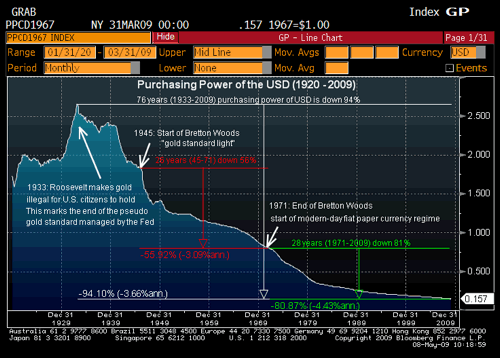
One investment, more than any other, has proven to be a terrible storehouse of value for well over 80 years.
While some disasters unfold rapidly (Enron, subprime mortgages, etc.), this investment’s decline has occurred in slow motion, losing an average of 3.6% a year. Indeed, you can hardly find a period in the last 89 years in which this investment actually MADE money.
That investment is the dollar.
Source: Zero Hedge
The above chart shows the history of the dollar’s purchasing power going back to the 1920s. All told the dollar has lost 94% of its purchasing power since we abandoned the gold standard. The most dramatic loss in purchasing power occurred directly after Roosevelt made it illegal to own gold. However, with few exceptions, the dollar has been spiraling downward ever since 1920.
After Nixon ended Bretton Woods (legislation that pegged the dollar to gold indirectly), the pace of purchasing power destruction accelerated with the dollar losing an average of 4.4% in purchasing power annually.
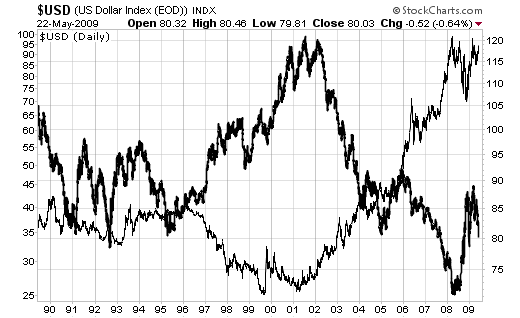
Gold and the Dollar have maintained an inverse relationship ever since this time. One zigs, the other zags. One rallies, the other falls. And starting in 2000, both entered long-term trends: the dollar falling while gold rallied (see the below chart).
Now, nothing ever goes straight up OR straight down. And starting in June 2008, the dollar erupted in its strongest rally in decades, jumping 22% in eight months. The story here was easy to understand, although most of the media ignored it.
With the dollar continually in decline and interest rates well below the rate of inflation in the post-Tech Crash, foreign corporations and institutional investors borrowed heavily in dollars.
Doing this meant their debts were continually shrinking relative to their profits (sales were denominated in a currency that was rising relative to the currency in which their debts were denominated). This meant their debts were easier to pay off.
However, when the dollar started a rally in July ’08, this positioning began going horribly wrong. Anyone short the dollar got killed and had to cover their shorts (buy dollars) which in turn pushed the dollar higher. At one point there were an estimated $9 trillion in dollar shorts in the world. So the dollar rally was the mother of all short squeezes. And as you can see, it kicked gold in the teeth.
However, with the Feds running the printing presses and inflationary concerns hitting the market (oil and most industrial commodities have soared in the last three months), the dollar’s rise may have come to an end. If the dollar breaks below 79 in a meaningful way, it’s “look out below” time. Which should put gold above $1,000 in a sustainable way.
My co-editor Paul wrote last week that based on the historic trends in the last gold bull market (1970-80) he expected gold to begin its next leg up this fall. However, looking at the dollar vs. gold chart above, it may already be happening. Watch these two investments closely. We may be on the verge of a truly seismic shift between the gold and the dollar.
Good Investing!
You can see the charts here... too lazy to upload them.:)
http://seekingalpha.com/article/139722-u-s-dollar-worst-investment-ever
Enjoy!
One investment, more than any other, has proven to be a terrible storehouse of value for well over 80 years.
While some disasters unfold rapidly (Enron, subprime mortgages, etc.), this investment’s decline has occurred in slow motion, losing an average of 3.6% a year. Indeed, you can hardly find a period in the last 89 years in which this investment actually MADE money.
That investment is the dollar.
Source: Zero Hedge
The above chart shows the history of the dollar’s purchasing power going back to the 1920s. All told the dollar has lost 94% of its purchasing power since we abandoned the gold standard. The most dramatic loss in purchasing power occurred directly after Roosevelt made it illegal to own gold. However, with few exceptions, the dollar has been spiraling downward ever since 1920.
After Nixon ended Bretton Woods (legislation that pegged the dollar to gold indirectly), the pace of purchasing power destruction accelerated with the dollar losing an average of 4.4% in purchasing power annually.
Gold and the Dollar have maintained an inverse relationship ever since this time. One zigs, the other zags. One rallies, the other falls. And starting in 2000, both entered long-term trends: the dollar falling while gold rallied (see the below chart).
Now, nothing ever goes straight up OR straight down. And starting in June 2008, the dollar erupted in its strongest rally in decades, jumping 22% in eight months. The story here was easy to understand, although most of the media ignored it.
With the dollar continually in decline and interest rates well below the rate of inflation in the post-Tech Crash, foreign corporations and institutional investors borrowed heavily in dollars.
Doing this meant their debts were continually shrinking relative to their profits (sales were denominated in a currency that was rising relative to the currency in which their debts were denominated). This meant their debts were easier to pay off.
However, when the dollar started a rally in July ’08, this positioning began going horribly wrong. Anyone short the dollar got killed and had to cover their shorts (buy dollars) which in turn pushed the dollar higher. At one point there were an estimated $9 trillion in dollar shorts in the world. So the dollar rally was the mother of all short squeezes. And as you can see, it kicked gold in the teeth.
However, with the Feds running the printing presses and inflationary concerns hitting the market (oil and most industrial commodities have soared in the last three months), the dollar’s rise may have come to an end. If the dollar breaks below 79 in a meaningful way, it’s “look out below” time. Which should put gold above $1,000 in a sustainable way.
My co-editor Paul wrote last week that based on the historic trends in the last gold bull market (1970-80) he expected gold to begin its next leg up this fall. However, looking at the dollar vs. gold chart above, it may already be happening. Watch these two investments closely. We may be on the verge of a truly seismic shift between the gold and the dollar.
Good Investing!
You can see the charts here... too lazy to upload them.:)
http://seekingalpha.com/article/139722-u-s-dollar-worst-investment-ever
Wednesday, April 8, 2009
Iraqi Dinar Value-So Cute The Fledgling Democracy Has Embezzlement. Long Way To Go Before You Come Close To Illinois...
 Hey...It Wasn't Me...It was the Other Guy That Looks Just Like Me With The Exact Same Name...
Iraqi Outgoing Provincial Chief Suspected Of Embezzling $130 Million
Monday April 6th, 2009 / 15h44
BAQOUBA, Iraq (AFP)--An arrest warrant has been issued for an outgoing Iraqi provincial council chief for allegedly misappropriating nearly $130 million in public funds, police said Monday.
"The judicial authorities have issued an arrest warrant against Ibrahim Hassan Bajilan, who is suspected of embezzlement," said an official in Baqouba, capital of the province of Diyala northeast of Baghdad. However Bajilan, a member of Iraqi President Jalal Talabani's Patriotic Union of Kurdistan, or PUK, party, denied the allegation.
"It is completely false," he told AFP by telephone. "It was me who contacted the authorities, and judicial sources in Diyala province assured me it was someone with the same name who is being sought. It certainly isn't me!" Mahdi Saleh, a provincial councilor with the Islamic Party, told AFP that when the accounts for 2008 were being done "we discovered expenditure on fictitious projects and unjustified cash deposits in his accounts.
"Anti-corruption officials have asked Bajilan to reimburse 150 billion dinars ($128 million) to the state. He has refused. So the council referred the case to the judicial authorities," Saleh said. Iraq staged provincial elections Jan. 31 in 14 of the country's 18 provinces, including Diyala.
Click here to go to Dow Jones NewsPlus, a web front page of today's most important business and market news, analysis and commentary: http://www.djnewsplus.com/access/al?rnd=Jl1NcgUwprDy09IF7LuIhw%3D%3D. You can use this link on the day this article is published and the following day
Subscribe to:
Posts (Atom)

 Posts
Posts