The Iraqi dinar is the official currency of Iraq. The nation stays largely isolated from global financial markets. The nation has no real sovereign credit, there is small need for its money which stays thinly traded. All Iraqi property, including its money are viewed as currently being a very great financial risk. The Iraqi dinar value, or the Iraqi dinar exchange rate, is effectively determined through the central bank through it's US currency auctions. The Iraq dinar was initially launched in 1932 when Iraq grew to become independent from British rule. The dinar changed the Indian rupee that had been launched by the British following winning control of Iraq from Turkey in WWI. The Iraqi dinar continues to be a managed or controlled currency throughout its existence.
Initially, when it was first placed into circulation, the Iraqi dinar was pegged towards the British pound. By 1959 Iraqi nationwide wealth had proved to be more and more coupled with oil. Oil was priced and traded globally in terms from the US currency, so the Iraqi currency peg was altered within the path of the US dollar and stays so today. After the initial US Gulf Struggle and the imposition of UN financial sanctions, financial conditions inside Iraq worsened sharply. By 1993, inflation had rocketed to an amazing yearly rate of more than 1000 percent, unemployment was at a massive fifty percent and also the Iraqi dinar exchange rate dropped considerably. Throughout 1994, it required about 2,500 dinars to buy one US dollar. To help the dinar, numerous measures had been launched in 1996 such as new regulations allowing Iraqi citizens to own overseas money financial institution accounts.
Following the 2nd Gulf War, new preparations had been created to take effect on 15 October 2003 to issue a new Iraqi dinar and to manage the Iraqi dinar exchange rate. Since those new arrangements have been launched, the Iraqi dinar value has steadily increased. The current exchange rate is 1,170 dinars for 1 US dollar. Figures published through the Central Intelligence Agency (CIA) in its World Fact Book display the number of Iraqi dinars needed to purchase 1 US dollar was at 1,475 dinars in 2005, 1,466 in 2006, 1,255 in 2007, 1,176 in 2008 and 1,170 in 2009. All indicators point to the presently prevailing exchange rate gradually increasing in the not too distant future.
Iraq just lately quantified its confirmed raw oil reserves at 143 billion barrels, in comparison with Saudi Arabia with 265 billion barrels of confirmed reserves. The nice part about these reserves are that they are effortlessly accessible and as a result the oil is cheap to produce. Roughly 95% of all Iraqi export value is derived from crude oil.
In the long run, as political balance returns to Iraq, its financial programs gains efficiencies and its citizens capture the full value of the national crude oil wealth, the Iraqi dinar value might be anticipated to strengthen considerably over its current trading valuations.
There are other sources and articles on the subject of Iraqi dinar value listed below.


Showing posts with label buying iraqi dinar. Show all posts
Showing posts with label buying iraqi dinar. Show all posts
Sunday, December 26, 2010


Saturday, August 22, 2009
Iraqi Dinar Value - Civil war in Iraq is still a real possibility
Civil war in Iraq is still a real possibility
REALPOLITIK: David Pratt
ISN'T IT strange the way we seem to have taken our eye off the ball when it comes to events in Iraq? Preoccupied with the growing violence and rising British casualty rate in Afghanistan, suddenly it seems we have no appetite for news coming out of places like Baghdad, Basra, Kirkuk and Mosul. It was not always like this, of course. Barely a few years ago Afghanistan was dubbed the "forgotten war" as world attention focused on defeating the insurgency in Iraq.
Today it is a different story, with our coverage only picking up when the death toll cannot be ignored. This was graphically illustrated last week when TV pictures showed the effects of bomb and mortar attacks that killed 95 people and wounded more than 500 in Baghdad.
Beyond these images of carnage, however, there is a distinct lack of incisive behind-the-headlines coverage precisely at the moment when Iraq's ethnic and religious faultlines once again appear to be cracking.
The implications of this fracturing could be profound not only for Iraq and its people but for the ongoing war against the Taliban in Afghanistan, recently bolstered by US and British troops redeployed there after the draw-down in Iraq.
As any intelligence analyst will confirm, it is often the accumulation of small details from comparatively insignificant individual events that point to the bigger long-term picture.
For example, take the seemingly run-of-the-mill report from Iraq last Friday about the discovery of a member of the Kurdish Peshmerga security forces found riddled with bullets in west Mosul. By Iraq's standards, nothing particularly unusual there, you might say. But this latest fatality is one of more than 100 deaths in mixed Arab-Kurdish areas over the past month.
While last week's explosion of violence in Baghdad appeared to be motivated by the now familiar - albeit still worrying - sectarian conflict between Shia and Sunni insurgents, there are now other potentially more dangerous battle lines being drawn across the country. Most notably, that between Baghdad and the Iraqi Kurdish government based in the northern city of Erbil. At the core of this stand-off lie the Kurdish government's plans to expand the land under its control and the oil reserves it contains. Baghdad is unlikely to stand idly by and let this happen.
Last month, it was hoped that Iraqi Kurdistan's landmark election might ease the tension in this dispute over resources and territory, but the death toll on the ground suggests otherwise. Observers now consistently refer to the Arab-Kurdish "trigger-line", while US defence secretary Robert Gates recently identified the dispute between Baghdad and the Kurds as the single biggest threat to the country's stability.
Any confrontation with Baghdad arouses intense passions among Kurds who still remember Saddam Hussein's genocidal assaults such as Operation Anfal, which resulted in the deaths of tens of thousands of innocent civilians in the 1980s. While three years ago it was the Sunni-Shia divide that threatened to plunge Iraq into civil war, today it is this old antagonism between Arab and Kurd that could tip the country over the edge.
Not surprisingly, in an effort to defuse this mounting tension, the US military is proposing to deploy troops for the first time in a strip of disputed territory in northern Iraq. Last Monday, the top American general in Iraq, Ray Odierno, said US troops would be stationed alongside Iraqi security forces and Kurdish Peshmerga militiamen in the province of Nineveh, near oil-rich Kirkuk, the scene of several recent high-profile bombings and shootings like that of the Kurdish Peshmerga soldier on Friday.
While Odierno insists the US involvement will not be "full-on", it must be the last thing Washington needs as it struggles to keep tabs on the situation in Baghdad and commit to containing the Taliban threat in Afghanistan in the wake of controversial elections there. So much for President Barack Obama's hopes of having all US combat troops out of Iraq within 12 months.
For the moment, any proper lasting peace remains a pipe dream for many ordinary Iraqis and it will stay that way if the security situation is once again allowed to unravel. These days, from Mosul to Baghdad, the countless individual killings of Kurd and Arab, Sunni and Shia often fail to make the headlines. But be under no illusions, their cumulative impact could yet drag Iraq into the abyss.
REALPOLITIK: David Pratt
ISN'T IT strange the way we seem to have taken our eye off the ball when it comes to events in Iraq? Preoccupied with the growing violence and rising British casualty rate in Afghanistan, suddenly it seems we have no appetite for news coming out of places like Baghdad, Basra, Kirkuk and Mosul. It was not always like this, of course. Barely a few years ago Afghanistan was dubbed the "forgotten war" as world attention focused on defeating the insurgency in Iraq.
Today it is a different story, with our coverage only picking up when the death toll cannot be ignored. This was graphically illustrated last week when TV pictures showed the effects of bomb and mortar attacks that killed 95 people and wounded more than 500 in Baghdad.
Beyond these images of carnage, however, there is a distinct lack of incisive behind-the-headlines coverage precisely at the moment when Iraq's ethnic and religious faultlines once again appear to be cracking.
The implications of this fracturing could be profound not only for Iraq and its people but for the ongoing war against the Taliban in Afghanistan, recently bolstered by US and British troops redeployed there after the draw-down in Iraq.
As any intelligence analyst will confirm, it is often the accumulation of small details from comparatively insignificant individual events that point to the bigger long-term picture.
For example, take the seemingly run-of-the-mill report from Iraq last Friday about the discovery of a member of the Kurdish Peshmerga security forces found riddled with bullets in west Mosul. By Iraq's standards, nothing particularly unusual there, you might say. But this latest fatality is one of more than 100 deaths in mixed Arab-Kurdish areas over the past month.
While last week's explosion of violence in Baghdad appeared to be motivated by the now familiar - albeit still worrying - sectarian conflict between Shia and Sunni insurgents, there are now other potentially more dangerous battle lines being drawn across the country. Most notably, that between Baghdad and the Iraqi Kurdish government based in the northern city of Erbil. At the core of this stand-off lie the Kurdish government's plans to expand the land under its control and the oil reserves it contains. Baghdad is unlikely to stand idly by and let this happen.
Last month, it was hoped that Iraqi Kurdistan's landmark election might ease the tension in this dispute over resources and territory, but the death toll on the ground suggests otherwise. Observers now consistently refer to the Arab-Kurdish "trigger-line", while US defence secretary Robert Gates recently identified the dispute between Baghdad and the Kurds as the single biggest threat to the country's stability.
Any confrontation with Baghdad arouses intense passions among Kurds who still remember Saddam Hussein's genocidal assaults such as Operation Anfal, which resulted in the deaths of tens of thousands of innocent civilians in the 1980s. While three years ago it was the Sunni-Shia divide that threatened to plunge Iraq into civil war, today it is this old antagonism between Arab and Kurd that could tip the country over the edge.
Not surprisingly, in an effort to defuse this mounting tension, the US military is proposing to deploy troops for the first time in a strip of disputed territory in northern Iraq. Last Monday, the top American general in Iraq, Ray Odierno, said US troops would be stationed alongside Iraqi security forces and Kurdish Peshmerga militiamen in the province of Nineveh, near oil-rich Kirkuk, the scene of several recent high-profile bombings and shootings like that of the Kurdish Peshmerga soldier on Friday.
While Odierno insists the US involvement will not be "full-on", it must be the last thing Washington needs as it struggles to keep tabs on the situation in Baghdad and commit to containing the Taliban threat in Afghanistan in the wake of controversial elections there. So much for President Barack Obama's hopes of having all US combat troops out of Iraq within 12 months.
For the moment, any proper lasting peace remains a pipe dream for many ordinary Iraqis and it will stay that way if the security situation is once again allowed to unravel. These days, from Mosul to Baghdad, the countless individual killings of Kurd and Arab, Sunni and Shia often fail to make the headlines. But be under no illusions, their cumulative impact could yet drag Iraq into the abyss.
Thursday, August 20, 2009
iraqi dinar value - Iraq attacks threaten stability claims
Iraq attacks threaten stability claims
By Magdi Abdelhadi BBC Arab affairs analyst
There is clearly a sense that violence in Iraq has been on the way up since the American troops pulled out of urban centres at the end of June.
But it is still not as high as it used to be three years ago, when the country appeared to be on the brink of an all-out sectarian war between the majority Shia and Sunni insurgents.
However, the frequency of the recent attacks - and the fact that the latest blasts hit the heart of government in central Baghdad, will raise questions about the competence of the Iraqi security services as well as about the motives.
Whether it is primarily sectarian or not, the apparent aim of the violence has almost always been to destabilise Iraq and show the government losing control.
This view appears to be even more plausible now as Iraqi politicians have begun preparing for forthcoming parliamentary elections due early next year.
Should continued violence force a change to those plans, this would be a serious blow to President Obama, who has made orderly military disengagement from Iraq one of his top foreign policy priorities.
Increased violence could in theory make it difficult for parties in the current governing coalition to claim that they have made Iraq safe again.
This has led some analysts to conclude that those behind the recent attacks are not only the usual suspects - al-Qaeda or former Baathists - but also political players who want scupper Prime Minister Nuri Maliki's hopes for another electoral victory.
If the current level of violence persists or, worse still, escalates, and American troops are called upon to intervene, this could seriously undermine claims that Iraq was on the right track to genuine independence.
Aside from the human cost of the violence, the main losers would be Mr Maliki and his coalition partners from the Shia majority, who have been the main beneficiaries of the new political order in Iraq.
Continued or increased violence could also easily increase the risk of wider regional troubles, with Iraq's neighbours backing one group against its rivals to ensure an outcome favourable to their national interests.
Iraq and Washington had agreed that all American troops will have withdrawn by the end of 2011.
Should continued violence force a change to those plans, this would be a serious blow to US President Barack Obama, who has made orderly military disengagement from Iraq one of his top foreign policy priorities.
By Magdi Abdelhadi BBC Arab affairs analyst
There is clearly a sense that violence in Iraq has been on the way up since the American troops pulled out of urban centres at the end of June.
But it is still not as high as it used to be three years ago, when the country appeared to be on the brink of an all-out sectarian war between the majority Shia and Sunni insurgents.
However, the frequency of the recent attacks - and the fact that the latest blasts hit the heart of government in central Baghdad, will raise questions about the competence of the Iraqi security services as well as about the motives.
Whether it is primarily sectarian or not, the apparent aim of the violence has almost always been to destabilise Iraq and show the government losing control.
This view appears to be even more plausible now as Iraqi politicians have begun preparing for forthcoming parliamentary elections due early next year.
Should continued violence force a change to those plans, this would be a serious blow to President Obama, who has made orderly military disengagement from Iraq one of his top foreign policy priorities.
Increased violence could in theory make it difficult for parties in the current governing coalition to claim that they have made Iraq safe again.
This has led some analysts to conclude that those behind the recent attacks are not only the usual suspects - al-Qaeda or former Baathists - but also political players who want scupper Prime Minister Nuri Maliki's hopes for another electoral victory.
If the current level of violence persists or, worse still, escalates, and American troops are called upon to intervene, this could seriously undermine claims that Iraq was on the right track to genuine independence.
Aside from the human cost of the violence, the main losers would be Mr Maliki and his coalition partners from the Shia majority, who have been the main beneficiaries of the new political order in Iraq.
Continued or increased violence could also easily increase the risk of wider regional troubles, with Iraq's neighbours backing one group against its rivals to ensure an outcome favourable to their national interests.
Iraq and Washington had agreed that all American troops will have withdrawn by the end of 2011.
Should continued violence force a change to those plans, this would be a serious blow to US President Barack Obama, who has made orderly military disengagement from Iraq one of his top foreign policy priorities.
Sunday, June 14, 2009
Iraqi Dinar Value - Protection For Iraq's Funds Extended For One Year
Thanks Ken
http://www.dealorbuydinar.com
Got to keep the CASH flowing and safe to sustain the recovery of Iraqi Dinar...
Protection for Iraq's funds extended for one year
June 4, 2009 - 01:01:46BAGHDAD / Aswat al-Iraq:
A U.S. embassy official said that the U.S. president has agreed to extend protection for money deposited in the Development Fund for Iraq (DFI) for another year, according to the head of Iraq's Board of Supreme Audit."The anti-corruption coordinator at the U.S. embassy in Baghdad, Joseph Stafford, said that the U.S. president has agreed to the extension for one more year," a statement received by Aswat al-Iraq news agency quoted Abdulbasit Turki as saying.
An estimated $20-30 billion U.S. dollars is believed to be deposited in the DFI, according to officials.In May 2003, following the invasion of Iraq in March of that year, the Central Bank of Iraq-Development Fund for Iraq (DFI) account was created at the U.S. Federal Reserve Bank of New York at the request of the Coalition Provisional Authority (CPA) Administrator.
A part of the fund has been transferred to Baghdad and Iraq, and the DFI-Baghdad account was opened at the Central Bank of Iraq "for cash payment requirements". The DFI have been disbursed mainly for "the wheat purchase program, the currency exchange program, the electricity and oil infrastructure programs, equipment for Iraqis security forces, and for Iraqi civil service salaries and ministry budget operations".SS (S)/SRhttp://en.aswataliraq.info/?p=114127
http://www.dealorbuydinar.com
Got to keep the CASH flowing and safe to sustain the recovery of Iraqi Dinar...
Protection for Iraq's funds extended for one year
June 4, 2009 - 01:01:46BAGHDAD / Aswat al-Iraq:
A U.S. embassy official said that the U.S. president has agreed to extend protection for money deposited in the Development Fund for Iraq (DFI) for another year, according to the head of Iraq's Board of Supreme Audit."The anti-corruption coordinator at the U.S. embassy in Baghdad, Joseph Stafford, said that the U.S. president has agreed to the extension for one more year," a statement received by Aswat al-Iraq news agency quoted Abdulbasit Turki as saying.
An estimated $20-30 billion U.S. dollars is believed to be deposited in the DFI, according to officials.In May 2003, following the invasion of Iraq in March of that year, the Central Bank of Iraq-Development Fund for Iraq (DFI) account was created at the U.S. Federal Reserve Bank of New York at the request of the Coalition Provisional Authority (CPA) Administrator.
A part of the fund has been transferred to Baghdad and Iraq, and the DFI-Baghdad account was opened at the Central Bank of Iraq "for cash payment requirements". The DFI have been disbursed mainly for "the wheat purchase program, the currency exchange program, the electricity and oil infrastructure programs, equipment for Iraqis security forces, and for Iraqi civil service salaries and ministry budget operations".SS (S)/SRhttp://en.aswataliraq.info/?p=114127
Wednesday, June 10, 2009
Current Value Iraqi Dinar - U.S. Dollar - Worst Investment Ever?
I got a good chuckle out of this...
Enjoy!
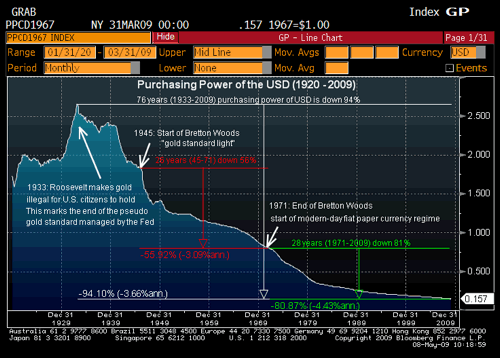
One investment, more than any other, has proven to be a terrible storehouse of value for well over 80 years.
While some disasters unfold rapidly (Enron, subprime mortgages, etc.), this investment’s decline has occurred in slow motion, losing an average of 3.6% a year. Indeed, you can hardly find a period in the last 89 years in which this investment actually MADE money.
That investment is the dollar.
Source: Zero Hedge
The above chart shows the history of the dollar’s purchasing power going back to the 1920s. All told the dollar has lost 94% of its purchasing power since we abandoned the gold standard. The most dramatic loss in purchasing power occurred directly after Roosevelt made it illegal to own gold. However, with few exceptions, the dollar has been spiraling downward ever since 1920.
After Nixon ended Bretton Woods (legislation that pegged the dollar to gold indirectly), the pace of purchasing power destruction accelerated with the dollar losing an average of 4.4% in purchasing power annually.
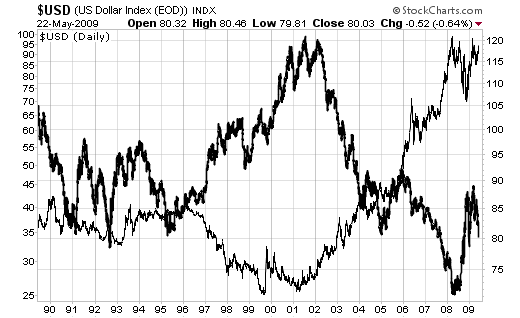
Gold and the Dollar have maintained an inverse relationship ever since this time. One zigs, the other zags. One rallies, the other falls. And starting in 2000, both entered long-term trends: the dollar falling while gold rallied (see the below chart).
Now, nothing ever goes straight up OR straight down. And starting in June 2008, the dollar erupted in its strongest rally in decades, jumping 22% in eight months. The story here was easy to understand, although most of the media ignored it.
With the dollar continually in decline and interest rates well below the rate of inflation in the post-Tech Crash, foreign corporations and institutional investors borrowed heavily in dollars.
Doing this meant their debts were continually shrinking relative to their profits (sales were denominated in a currency that was rising relative to the currency in which their debts were denominated). This meant their debts were easier to pay off.
However, when the dollar started a rally in July ’08, this positioning began going horribly wrong. Anyone short the dollar got killed and had to cover their shorts (buy dollars) which in turn pushed the dollar higher. At one point there were an estimated $9 trillion in dollar shorts in the world. So the dollar rally was the mother of all short squeezes. And as you can see, it kicked gold in the teeth.
However, with the Feds running the printing presses and inflationary concerns hitting the market (oil and most industrial commodities have soared in the last three months), the dollar’s rise may have come to an end. If the dollar breaks below 79 in a meaningful way, it’s “look out below” time. Which should put gold above $1,000 in a sustainable way.
My co-editor Paul wrote last week that based on the historic trends in the last gold bull market (1970-80) he expected gold to begin its next leg up this fall. However, looking at the dollar vs. gold chart above, it may already be happening. Watch these two investments closely. We may be on the verge of a truly seismic shift between the gold and the dollar.
Good Investing!
You can see the charts here... too lazy to upload them.:)
http://seekingalpha.com/article/139722-u-s-dollar-worst-investment-ever
Enjoy!
One investment, more than any other, has proven to be a terrible storehouse of value for well over 80 years.
While some disasters unfold rapidly (Enron, subprime mortgages, etc.), this investment’s decline has occurred in slow motion, losing an average of 3.6% a year. Indeed, you can hardly find a period in the last 89 years in which this investment actually MADE money.
That investment is the dollar.
Source: Zero Hedge
The above chart shows the history of the dollar’s purchasing power going back to the 1920s. All told the dollar has lost 94% of its purchasing power since we abandoned the gold standard. The most dramatic loss in purchasing power occurred directly after Roosevelt made it illegal to own gold. However, with few exceptions, the dollar has been spiraling downward ever since 1920.
After Nixon ended Bretton Woods (legislation that pegged the dollar to gold indirectly), the pace of purchasing power destruction accelerated with the dollar losing an average of 4.4% in purchasing power annually.
Gold and the Dollar have maintained an inverse relationship ever since this time. One zigs, the other zags. One rallies, the other falls. And starting in 2000, both entered long-term trends: the dollar falling while gold rallied (see the below chart).
Now, nothing ever goes straight up OR straight down. And starting in June 2008, the dollar erupted in its strongest rally in decades, jumping 22% in eight months. The story here was easy to understand, although most of the media ignored it.
With the dollar continually in decline and interest rates well below the rate of inflation in the post-Tech Crash, foreign corporations and institutional investors borrowed heavily in dollars.
Doing this meant their debts were continually shrinking relative to their profits (sales were denominated in a currency that was rising relative to the currency in which their debts were denominated). This meant their debts were easier to pay off.
However, when the dollar started a rally in July ’08, this positioning began going horribly wrong. Anyone short the dollar got killed and had to cover their shorts (buy dollars) which in turn pushed the dollar higher. At one point there were an estimated $9 trillion in dollar shorts in the world. So the dollar rally was the mother of all short squeezes. And as you can see, it kicked gold in the teeth.
However, with the Feds running the printing presses and inflationary concerns hitting the market (oil and most industrial commodities have soared in the last three months), the dollar’s rise may have come to an end. If the dollar breaks below 79 in a meaningful way, it’s “look out below” time. Which should put gold above $1,000 in a sustainable way.
My co-editor Paul wrote last week that based on the historic trends in the last gold bull market (1970-80) he expected gold to begin its next leg up this fall. However, looking at the dollar vs. gold chart above, it may already be happening. Watch these two investments closely. We may be on the verge of a truly seismic shift between the gold and the dollar.
Good Investing!
You can see the charts here... too lazy to upload them.:)
http://seekingalpha.com/article/139722-u-s-dollar-worst-investment-ever
Friday, April 3, 2009
Iraqi Dinar-For Those Of You Who Say We Should Have Never Gone In...

...THEN NOTHING WOULD HAVE CHANGED!
Saddam's palace still tells a story
Tim Albone, Foreign Correspondent
Last Updated: March 23. 2009 8:30AM UAE / March 23. 2009 4:30AM GMT
Schoolchildren tour Saddam Hussein’s Babylon palace, which retains little of its former glory. Tim Albone for The National
BABYLON, IRAQ // It sits atop a man-made hill overlooking the ancient city of Babylon. In its prime – with its swimming pool, Roman-inspired columns, chandeliers and bathrooms complete with jacuzzis – it was a testament to the gluttony of the Baathist regime.Today, gutted and looted, Saddam Hussein’s three-storey palace that overlooks the Euphrates River only hints at its former glory. The windows are smashed, the chandeliers broken and the swimming pool empty. The furniture is gone and the walls are covered in graffiti. Even the toilets have been removed. It serves as a graphic reminder of the pillaging and looting that went unpunished and unchecked after the US-led invasion of 2003.
Whereas once Saddam would have entertained guests and heads of state with sumptuous feasts and lavish parties at the estate, today schoolchildren visit. “They want to see how Saddam lived and how bad he was with the people. If you go to Hillah [a nearby town] you will see the small houses,” said Hussam Kadhim, 44, the manager of the site. He hopes that by showing the palace, decrepit as it is, the inequality of the former regime can be highlighted. While the ruler lived in luxury, most of the population remained poor.
Mr Kadhim, who works for the local government, said plans were under way to redevelop the site and turn it into a conference centre.He said it could, if security improved, even draw people from abroad for conferences. With its proximity to the ancient city of Babylon, luring archaeological buffs is another possibility.“They have a plan … and they [the government] are giving us the money to renovate.
Mr Kadhim estimates that to get the palace back to its former glory would cost about seven billion Iraqi dinar (Dh22 million).Already nearly 1,000 people a day come to visit and pay 1,000 dinar just to look at the building and to have a picnic in the grounds. Although some out-of-towners have visited, the majority come from nearby Hillah. Despite security concerns – a suicide bomb killed 10 people in Hillah this month – redevelopment has already started at a rapid pace. Chalets that used to house soldiers from Saddam’s special forces and presidential guard have been turned into hotel rooms. For 200,000 dinar you can rent a room complete with private bathroom, widescreen television and king-size bed.
Mr Kadhim has already had Ahmed Chalabi, the former deputy prime minster, as a guest. He hopes that, in time, the proximity to Baghdad and the luxury will draw couples and honeymooners.“It wasn’t even in my dreams that one day he [Saddam] would be gone and people could come here. They would have been arrested,” said Mr Kadhim, who worked as a government employee under Saddam.As the site has opened up it has offered some remarkable insights into the megalomania of the former ruler. The man-made hill, on which he built his palace, was placed on top of some of Babylon’s ancient ruins.
“They are lost forever,” said Abdul Satar Naji, 46, the security manager at the site.Then there is Saddam’s date tree. No different to the hundreds of others that dot the grounds except that it is surrounded by a concrete wall. “It was Saddam’s date tree and he made people take special care of it, only he could eat from it,” Mr Naji said.The bricks inscribed with immodest poetry about the “great Saddam” hint at his arrogance.
The Americans, who occupied the palace until 2005, have left their own mark. “To my Mom and Dad Happy Mothers/Fathers day. From Saddam Palace 30 April 05 Love your son Roy,” reads one scrawl. “Hooah”, says another in reference to the army’s battle cry. A third says: “Brian loves Brandy.” The crude graffiti adds to the sense of frustration felt by those who work at the palace. Not only did the Americans come in and draw on the walls, looters were allowed to take millions of dinar’s worth of fixtures and furniture immediately after the invasion and right under the American’s noses.
“The Americans allowed people to take everything,” Mr Naji, said. Despite the massive redevelopment needed, Iraqis visiting the site were happy just to marvel at the sheer size of the palace.“When I first visited I couldn’t believe how big it was. I got sick walking up the stairs,” said Mr Naji, the security manager.“I’ve been here three years and I can’t tell you how many bedrooms or bathrooms there are.”
“Before we were prevented from coming here, we just heard about it on TV,” said Saha Shokil, a headmistress, who had brought 250 pupils to visit.Ali, 21, a student, dressed in a smart suit, said: “It’s bigger than I thought. I can’t imagine how he lived.”His friend, Mohammed, 20, also a student, said: “It makes me angry. Saddam used to live here and we were poor.”
Tuesday, March 31, 2009
Iraqi Dinar-Brits Tuck Tail And Run...Is Iraq Really Safer...Or Are They Cutting And Running?

So Is the Country Safer Or Are We The Last Ones Left Holding The Bag? Or is this a sure sign to go Long on Iraqi Dinar?
British hand off to US in oil-rich southern Iraq
By KIM GAMEL – 7 hours ago
BAGHDAD (AP) — Britain turned over coalition command of the oil-rich south to the United States on Tuesday in the first step toward withdrawing virtually all British troops from Iraq by July.
The pomp-filled ceremony marked the beginning of the end of an often-troubled British mission. The Iraqis have accused the British of merely standing by while Shiite militias wielded control of the country's second-largest city of Basra for years.
However, U.S. and Iraqi commanders had nothing but praise Tuesday for Britain's role as the second-largest contributor of troops since the U.S.-led invasion in March 2003.
"The accomplishments of the British forces across Iraq, and especially here in Basra, have been nothing short of brilliant," Gen. Ray Odierno, the top U.S. commander in Iraq, said during the ceremony at the airport base outside Basra, 340 miles (550 kilometers) southeast of Baghdad.
The British troops will be withdrawn in phases, with combat operations to finish at the end of May and all but about 400 troops withdrawn by the end of July. Those staying behind will focus mainly on training the Iraqi navy to defend oil platforms stationed off the coast, the British
Ministry of Defense has said.
The Americans will move units to replace the British troops to ensure a smooth transition, the military said. U.S. military supply lines pass through the area en route from Kuwait to U.S. bases throughout the country.
The Iraq war has been extremely unpopular in Britain, and the issue shadowed the final years of Tony Blair's premiership.
At the height of combat operations in March and April 2003, Britain had 46,000 troops in Iraq. The British military has suffered 179 deaths since the war started.
Violence has dropped off sharply in most of Iraq, but a spate of high-profile bombings this month has raised concern that insurgents are regrouping ahead of the planned withdrawal of U.S. forces from Iraqi cities by the end of June and from the rest of the country by the end of 2011.
The number of Iraqis killed in war-related violence rose 12 percent to at least 323 in March, including 87 security forces and 226 civilians, according to an Associated Press tally. That compared with 288 Iraqis killed in February.
The AP began tracking the figure in April 2005 based on reports by police, hospital officials, morgue workers and verifiable witness accounts.
These numbers are considered a minimum, based on AP reporting. The actual number is likely higher since many killings go unreported or uncounted. The security personnel include Iraqi military, police and police recruits, and bodyguards. Insurgent deaths are not included.
Also Tuesday, a suicide truck bomber struck an Iraqi police station in the northern city of Mosul, killing at least eight people — four policemen and four civilians — and wounding 12, officials said.
At least nine U.S. troop deaths were reported this month — less than half from combat, according to an AP tally.
The latest death occurred Tuesday, when a Marine died in a "noncombat incident" in Anbar province, west of Baghdad, the U.S. military said.
In all, at least 4,263 American service members have died in Iraq since the war began in March 2003, the AP tally shows.
Associated Press Writer Sinan Salaheddin and the AP News Research Center in New York contributed to this report.
Copyright © 2009 The Associated Press. All rights reserved.
howtobuydinar.org
Subscribe to:
Posts (Atom)

 Posts
Posts