Biden Pushes Iraqi Leaders On Vote Law, Oil-Bid Perks
By Scott Wilson
Washington Post Staff Writer
Thursday, September 17, 2009
BAGHDAD, Sept. 16 -- Vice President Biden pressed Iraqi leaders Wednesday to approve as quickly as possible legislation that establishes rules for the planned January general election and to make the next round of bids to develop Iraqi oil concessions more attractive to foreign investors.
In a series of meetings in the Green Zone, Biden listened to the concerns of Iraqi leaders, now in the heat of an election season that Obama administration officials acknowledge will delay until after the vote any progress on such pressing issues as passing a law on the equitable distribution of national oil revenue among Shiites, Sunnis and Kurds.
A senior administration official said Biden also made his interests known on a variety of issues, such as the need for the Iraqi parliament to adopt laws to better protect foreign investment and leaving unchanged the terms of the timetable for the withdrawal of the 130,000 U.S. troops now in the country.
This is Biden's second visit to Iraq in two months, and it comes as the Obama administration is trying to manage a growing Iraqi impatience with the U.S. military presence here. Prime Minister Nouri al-Maliki, whom Biden met with Wednesday evening, has expressed support for a proposed referendum that would hasten by a year the 2011 withdrawal deadline for all U.S. forces in Iraq.
U.S. military and diplomatic officials fear that a rapid departure could undermine the security gains realized over the past year, and in his meetings Biden asked Iraqi officials whether they thought the referendum would proceed. But Biden is reluctant to be seen as meddling in a domestic Iraqi issue, and a senior administration official said the vice president operated largely in "listening mode."
Speaking next to Biden at his official residence, Maliki said U.S. forces had complied with the terms of the agreement outlining the schedule for the troop withdrawal and the training of Iraqi forces with "high credibility."
Biden reiterated the terms of the withdrawal timeline. The senior administration official said the two men's statements mean "that we have a mutual interest in moving forward" under the conditions set out in the agreement.
Biden also appealed to Iraqi leaders to offer more financial incentives for foreign investors to bid on Iraqi oil concessions; only one bid of the eight put out this year was accepted. The administration official estimated that one additional deal would translate into $50 billion to $60 billion in foreign investment in Iraq, generate $600 million in annual revenue and create tens of thousands of jobs in the country.
The official said Biden would deliver the same message to Kurdish leaders in meetings scheduled for Thursday. Kurds' interest in ensuring what they see as a fair share of proceeds from the rich oil fields of Iraq's north has presented an obstacle to a revenue-sharing agreement. Reaching a deal is crucial to Iraq's oil-dependent economy, but the goal has been politically elusive for years.
"In an election season in any country, it's difficult to make definitive progress on any issue, and these are difficult issues," the official said, adding that Biden's hope is for the next Iraqi government to be "in good position" to move on the oil legislation and other matters soon after the election.
In all his meetings, Biden asked Iraqi officials to assess their progress on an election law, concerned that without one in place soon the January vote will not be able to proceed. The official said he particularly pressed Ayad al-Samarraie, speaker of the Iraqi parliament, because the law is a legislative matter.
Biden and Maliki expressed hope that the Iraq Business and Investment Conference scheduled to be held in Washington next month would encourage private U.S. investment in Iraq. But the administration source said Biden told Iraqi leaders that regulatory and other financial protections need to be enacted to make foreign investors more comfortable doing business here.
Some of the proposed protections are before parliament, the official said, and their passage would allow, among other things, for the Overseas Private Investment Corp. to extend loan guarantees to companies wishing to do business in Iraq.


Showing posts with label current value iraqi dinar. Show all posts
Showing posts with label current value iraqi dinar. Show all posts
Monday, September 21, 2009


Friday, August 21, 2009
Buy Iraqi Dinar - Iraq: Arrests made in ministry truck bombings
Iraq: Arrests made in ministry truck bombings
Story Highlights
Wednesday bombings of Finance, Foreign Affairs ministries killed more than 100
Iraqi official says suspects were arrested two hours after attacks
11 high-ranking security officials from the Iraqi army and police detained,
August 21, 2009 -- Updated 2003 GMT (0403 HKT)
BAGHDAD, Iraq (CNN) -- The Iraqi government said Friday it has arrested members of a cell believed responsible for Wednesday's truck bombings in which more than 100 people were killed.
Workers clear the site outside the ministries of Finance and Foreign Affairs in Baghdad.
Maj. Gen. Qassim Atta, spokesman for Baghdad Operations Command, appeared on Iraqi state television Friday night to announce the arrests, which he said were made within two hours of the bombings in the capital city. Those arrested include people believed to have planned and executed the attacks, Atta said.
It was not immediately clear how many people were arrested.
Initial investigations show a link between the cell and the ousted Baath regime of Saddam Hussein, Atta said. Authorities are also seeking people thought to have provided cell members with logistical support and identification, he said.
Iraq Security Forces recovered a truck Friday with five tons of C-4 explosives in the Abu Ghraib area, on the western outskirts of Baghdad, Atta said Friday night.
More than 500 people were wounded Wednesday in the six explosions in Baghdad.
In one attack, a truck bomb exploded outside the Ministry of Foreign Affairs. The blast blew through the front of the building, sending some vehicles flying and leaving others in mangled twists of metal in the area, which is just outside the restricted International Zone, also known as the Green Zone. Another truck bomb went off outside the Ministry of Finance building.
Authorities said Thursday that 11 high-ranking security officials from the Iraqi army and police were detained for investigation.
The Iraqi government in the past has made claims of arrests that did not hold up. In April, it said it had captured Abu Omar al-Baghdadi, the head of al Qaeda in Iraq's umbrella group, the Islamic State of Iraq. The Islamic State of Iraq denied it, and the capture was never confirmed by the U.S. military.
The explosions made Wednesday the country's deadliest day since the United States pulled its combat troops from Iraqi cities and towns nearly two months ago and left security in the hands of the Iraqis. The U.S. military remains in a training and advisory capacity in those areas and continues to conduct combat operations outside cities and towns.
Iraqi Prime Minister Nuri al-Maliki ordered increased security measures, including more checkpoints and more stringent vehicle searches across the capital, government officials said on Thursday.
The Iraqi government has been trying to restore what it described as normalcy to the streets of the capital in recent weeks. Al-Maliki ordered his government to take down within 40 days the concrete blast walls that line Baghdad's streets and protected neighborhoods at the height of the war. Many Iraqis have criticized the move as premature.
Story Highlights
Wednesday bombings of Finance, Foreign Affairs ministries killed more than 100
Iraqi official says suspects were arrested two hours after attacks
11 high-ranking security officials from the Iraqi army and police detained,
August 21, 2009 -- Updated 2003 GMT (0403 HKT)
BAGHDAD, Iraq (CNN) -- The Iraqi government said Friday it has arrested members of a cell believed responsible for Wednesday's truck bombings in which more than 100 people were killed.
Workers clear the site outside the ministries of Finance and Foreign Affairs in Baghdad.
Maj. Gen. Qassim Atta, spokesman for Baghdad Operations Command, appeared on Iraqi state television Friday night to announce the arrests, which he said were made within two hours of the bombings in the capital city. Those arrested include people believed to have planned and executed the attacks, Atta said.
It was not immediately clear how many people were arrested.
Initial investigations show a link between the cell and the ousted Baath regime of Saddam Hussein, Atta said. Authorities are also seeking people thought to have provided cell members with logistical support and identification, he said.
Iraq Security Forces recovered a truck Friday with five tons of C-4 explosives in the Abu Ghraib area, on the western outskirts of Baghdad, Atta said Friday night.
More than 500 people were wounded Wednesday in the six explosions in Baghdad.
In one attack, a truck bomb exploded outside the Ministry of Foreign Affairs. The blast blew through the front of the building, sending some vehicles flying and leaving others in mangled twists of metal in the area, which is just outside the restricted International Zone, also known as the Green Zone. Another truck bomb went off outside the Ministry of Finance building.
Authorities said Thursday that 11 high-ranking security officials from the Iraqi army and police were detained for investigation.
The Iraqi government in the past has made claims of arrests that did not hold up. In April, it said it had captured Abu Omar al-Baghdadi, the head of al Qaeda in Iraq's umbrella group, the Islamic State of Iraq. The Islamic State of Iraq denied it, and the capture was never confirmed by the U.S. military.
The explosions made Wednesday the country's deadliest day since the United States pulled its combat troops from Iraqi cities and towns nearly two months ago and left security in the hands of the Iraqis. The U.S. military remains in a training and advisory capacity in those areas and continues to conduct combat operations outside cities and towns.
Iraqi Prime Minister Nuri al-Maliki ordered increased security measures, including more checkpoints and more stringent vehicle searches across the capital, government officials said on Thursday.
The Iraqi government has been trying to restore what it described as normalcy to the streets of the capital in recent weeks. Al-Maliki ordered his government to take down within 40 days the concrete blast walls that line Baghdad's streets and protected neighborhoods at the height of the war. Many Iraqis have criticized the move as premature.
Thursday, August 20, 2009
iraqi dinar value - Iraq attacks threaten stability claims
Iraq attacks threaten stability claims
By Magdi Abdelhadi BBC Arab affairs analyst
There is clearly a sense that violence in Iraq has been on the way up since the American troops pulled out of urban centres at the end of June.
But it is still not as high as it used to be three years ago, when the country appeared to be on the brink of an all-out sectarian war between the majority Shia and Sunni insurgents.
However, the frequency of the recent attacks - and the fact that the latest blasts hit the heart of government in central Baghdad, will raise questions about the competence of the Iraqi security services as well as about the motives.
Whether it is primarily sectarian or not, the apparent aim of the violence has almost always been to destabilise Iraq and show the government losing control.
This view appears to be even more plausible now as Iraqi politicians have begun preparing for forthcoming parliamentary elections due early next year.
Should continued violence force a change to those plans, this would be a serious blow to President Obama, who has made orderly military disengagement from Iraq one of his top foreign policy priorities.
Increased violence could in theory make it difficult for parties in the current governing coalition to claim that they have made Iraq safe again.
This has led some analysts to conclude that those behind the recent attacks are not only the usual suspects - al-Qaeda or former Baathists - but also political players who want scupper Prime Minister Nuri Maliki's hopes for another electoral victory.
If the current level of violence persists or, worse still, escalates, and American troops are called upon to intervene, this could seriously undermine claims that Iraq was on the right track to genuine independence.
Aside from the human cost of the violence, the main losers would be Mr Maliki and his coalition partners from the Shia majority, who have been the main beneficiaries of the new political order in Iraq.
Continued or increased violence could also easily increase the risk of wider regional troubles, with Iraq's neighbours backing one group against its rivals to ensure an outcome favourable to their national interests.
Iraq and Washington had agreed that all American troops will have withdrawn by the end of 2011.
Should continued violence force a change to those plans, this would be a serious blow to US President Barack Obama, who has made orderly military disengagement from Iraq one of his top foreign policy priorities.
By Magdi Abdelhadi BBC Arab affairs analyst
There is clearly a sense that violence in Iraq has been on the way up since the American troops pulled out of urban centres at the end of June.
But it is still not as high as it used to be three years ago, when the country appeared to be on the brink of an all-out sectarian war between the majority Shia and Sunni insurgents.
However, the frequency of the recent attacks - and the fact that the latest blasts hit the heart of government in central Baghdad, will raise questions about the competence of the Iraqi security services as well as about the motives.
Whether it is primarily sectarian or not, the apparent aim of the violence has almost always been to destabilise Iraq and show the government losing control.
This view appears to be even more plausible now as Iraqi politicians have begun preparing for forthcoming parliamentary elections due early next year.
Should continued violence force a change to those plans, this would be a serious blow to President Obama, who has made orderly military disengagement from Iraq one of his top foreign policy priorities.
Increased violence could in theory make it difficult for parties in the current governing coalition to claim that they have made Iraq safe again.
This has led some analysts to conclude that those behind the recent attacks are not only the usual suspects - al-Qaeda or former Baathists - but also political players who want scupper Prime Minister Nuri Maliki's hopes for another electoral victory.
If the current level of violence persists or, worse still, escalates, and American troops are called upon to intervene, this could seriously undermine claims that Iraq was on the right track to genuine independence.
Aside from the human cost of the violence, the main losers would be Mr Maliki and his coalition partners from the Shia majority, who have been the main beneficiaries of the new political order in Iraq.
Continued or increased violence could also easily increase the risk of wider regional troubles, with Iraq's neighbours backing one group against its rivals to ensure an outcome favourable to their national interests.
Iraq and Washington had agreed that all American troops will have withdrawn by the end of 2011.
Should continued violence force a change to those plans, this would be a serious blow to US President Barack Obama, who has made orderly military disengagement from Iraq one of his top foreign policy priorities.
Sunday, June 14, 2009
Iraqi Dinar Value - Protection For Iraq's Funds Extended For One Year
Thanks Ken
http://www.dealorbuydinar.com
Got to keep the CASH flowing and safe to sustain the recovery of Iraqi Dinar...
Protection for Iraq's funds extended for one year
June 4, 2009 - 01:01:46BAGHDAD / Aswat al-Iraq:
A U.S. embassy official said that the U.S. president has agreed to extend protection for money deposited in the Development Fund for Iraq (DFI) for another year, according to the head of Iraq's Board of Supreme Audit."The anti-corruption coordinator at the U.S. embassy in Baghdad, Joseph Stafford, said that the U.S. president has agreed to the extension for one more year," a statement received by Aswat al-Iraq news agency quoted Abdulbasit Turki as saying.
An estimated $20-30 billion U.S. dollars is believed to be deposited in the DFI, according to officials.In May 2003, following the invasion of Iraq in March of that year, the Central Bank of Iraq-Development Fund for Iraq (DFI) account was created at the U.S. Federal Reserve Bank of New York at the request of the Coalition Provisional Authority (CPA) Administrator.
A part of the fund has been transferred to Baghdad and Iraq, and the DFI-Baghdad account was opened at the Central Bank of Iraq "for cash payment requirements". The DFI have been disbursed mainly for "the wheat purchase program, the currency exchange program, the electricity and oil infrastructure programs, equipment for Iraqis security forces, and for Iraqi civil service salaries and ministry budget operations".SS (S)/SRhttp://en.aswataliraq.info/?p=114127
http://www.dealorbuydinar.com
Got to keep the CASH flowing and safe to sustain the recovery of Iraqi Dinar...
Protection for Iraq's funds extended for one year
June 4, 2009 - 01:01:46BAGHDAD / Aswat al-Iraq:
A U.S. embassy official said that the U.S. president has agreed to extend protection for money deposited in the Development Fund for Iraq (DFI) for another year, according to the head of Iraq's Board of Supreme Audit."The anti-corruption coordinator at the U.S. embassy in Baghdad, Joseph Stafford, said that the U.S. president has agreed to the extension for one more year," a statement received by Aswat al-Iraq news agency quoted Abdulbasit Turki as saying.
An estimated $20-30 billion U.S. dollars is believed to be deposited in the DFI, according to officials.In May 2003, following the invasion of Iraq in March of that year, the Central Bank of Iraq-Development Fund for Iraq (DFI) account was created at the U.S. Federal Reserve Bank of New York at the request of the Coalition Provisional Authority (CPA) Administrator.
A part of the fund has been transferred to Baghdad and Iraq, and the DFI-Baghdad account was opened at the Central Bank of Iraq "for cash payment requirements". The DFI have been disbursed mainly for "the wheat purchase program, the currency exchange program, the electricity and oil infrastructure programs, equipment for Iraqis security forces, and for Iraqi civil service salaries and ministry budget operations".SS (S)/SRhttp://en.aswataliraq.info/?p=114127
Wednesday, June 10, 2009
Current Value Iraqi Dinar - U.S. Dollar - Worst Investment Ever?
I got a good chuckle out of this...
Enjoy!
One investment, more than any other, has proven to be a terrible storehouse of value for well over 80 years.
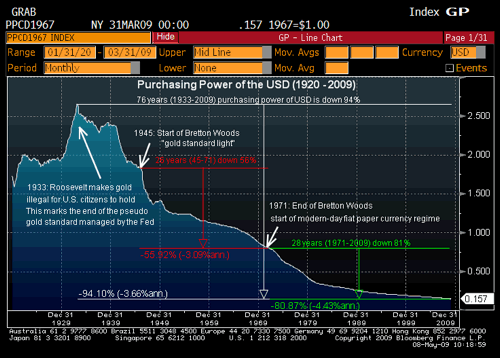
While some disasters unfold rapidly (Enron, subprime mortgages, etc.), this investment’s decline has occurred in slow motion, losing an average of 3.6% a year. Indeed, you can hardly find a period in the last 89 years in which this investment actually MADE money.
That investment is the dollar.
Source: Zero Hedge
The above chart shows the history of the dollar’s purchasing power going back to the 1920s. All told the dollar has lost 94% of its purchasing power since we abandoned the gold standard. The most dramatic loss in purchasing power occurred directly after Roosevelt made it illegal to own gold. However, with few exceptions, the dollar has been spiraling downward ever since 1920.
After Nixon ended Bretton Woods (legislation that pegged the dollar to gold indirectly), the pace of purchasing power destruction accelerated with the dollar losing an average of 4.4% in purchasing power annually.
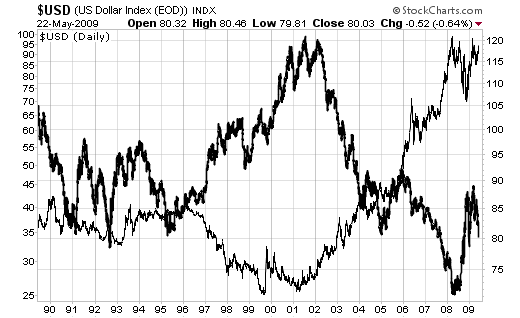
Gold and the Dollar have maintained an inverse relationship ever since this time. One zigs, the other zags. One rallies, the other falls. And starting in 2000, both entered long-term trends: the dollar falling while gold rallied (see the below chart).
Now, nothing ever goes straight up OR straight down. And starting in June 2008, the dollar erupted in its strongest rally in decades, jumping 22% in eight months. The story here was easy to understand, although most of the media ignored it.
With the dollar continually in decline and interest rates well below the rate of inflation in the post-Tech Crash, foreign corporations and institutional investors borrowed heavily in dollars.
Doing this meant their debts were continually shrinking relative to their profits (sales were denominated in a currency that was rising relative to the currency in which their debts were denominated). This meant their debts were easier to pay off.
However, when the dollar started a rally in July ’08, this positioning began going horribly wrong. Anyone short the dollar got killed and had to cover their shorts (buy dollars) which in turn pushed the dollar higher. At one point there were an estimated $9 trillion in dollar shorts in the world. So the dollar rally was the mother of all short squeezes. And as you can see, it kicked gold in the teeth.
However, with the Feds running the printing presses and inflationary concerns hitting the market (oil and most industrial commodities have soared in the last three months), the dollar’s rise may have come to an end. If the dollar breaks below 79 in a meaningful way, it’s “look out below” time. Which should put gold above $1,000 in a sustainable way.
My co-editor Paul wrote last week that based on the historic trends in the last gold bull market (1970-80) he expected gold to begin its next leg up this fall. However, looking at the dollar vs. gold chart above, it may already be happening. Watch these two investments closely. We may be on the verge of a truly seismic shift between the gold and the dollar.
Good Investing!
You can see the charts here... too lazy to upload them.:)
http://seekingalpha.com/article/139722-u-s-dollar-worst-investment-ever
Enjoy!
One investment, more than any other, has proven to be a terrible storehouse of value for well over 80 years.
While some disasters unfold rapidly (Enron, subprime mortgages, etc.), this investment’s decline has occurred in slow motion, losing an average of 3.6% a year. Indeed, you can hardly find a period in the last 89 years in which this investment actually MADE money.
That investment is the dollar.
Source: Zero Hedge
The above chart shows the history of the dollar’s purchasing power going back to the 1920s. All told the dollar has lost 94% of its purchasing power since we abandoned the gold standard. The most dramatic loss in purchasing power occurred directly after Roosevelt made it illegal to own gold. However, with few exceptions, the dollar has been spiraling downward ever since 1920.
After Nixon ended Bretton Woods (legislation that pegged the dollar to gold indirectly), the pace of purchasing power destruction accelerated with the dollar losing an average of 4.4% in purchasing power annually.
Gold and the Dollar have maintained an inverse relationship ever since this time. One zigs, the other zags. One rallies, the other falls. And starting in 2000, both entered long-term trends: the dollar falling while gold rallied (see the below chart).
Now, nothing ever goes straight up OR straight down. And starting in June 2008, the dollar erupted in its strongest rally in decades, jumping 22% in eight months. The story here was easy to understand, although most of the media ignored it.
With the dollar continually in decline and interest rates well below the rate of inflation in the post-Tech Crash, foreign corporations and institutional investors borrowed heavily in dollars.
Doing this meant their debts were continually shrinking relative to their profits (sales were denominated in a currency that was rising relative to the currency in which their debts were denominated). This meant their debts were easier to pay off.
However, when the dollar started a rally in July ’08, this positioning began going horribly wrong. Anyone short the dollar got killed and had to cover their shorts (buy dollars) which in turn pushed the dollar higher. At one point there were an estimated $9 trillion in dollar shorts in the world. So the dollar rally was the mother of all short squeezes. And as you can see, it kicked gold in the teeth.
However, with the Feds running the printing presses and inflationary concerns hitting the market (oil and most industrial commodities have soared in the last three months), the dollar’s rise may have come to an end. If the dollar breaks below 79 in a meaningful way, it’s “look out below” time. Which should put gold above $1,000 in a sustainable way.
My co-editor Paul wrote last week that based on the historic trends in the last gold bull market (1970-80) he expected gold to begin its next leg up this fall. However, looking at the dollar vs. gold chart above, it may already be happening. Watch these two investments closely. We may be on the verge of a truly seismic shift between the gold and the dollar.
Good Investing!
You can see the charts here... too lazy to upload them.:)
http://seekingalpha.com/article/139722-u-s-dollar-worst-investment-ever
Thursday, March 5, 2009
Iraqi Dinar
 Latest Headlines Regarding Iraqi Dinar
 - Oil price slump starves Iraq of funds
- Inflation slips to 9.2 percent
- 7.5 pct GDP growth in 2009 optimistic but attainable
- Iraq undecided on new IMF standby arrangement
By Missy Ryan and Wisam Mohammed
BAGHDAD, March 5 (Reuters) - The slump in oil prices will force Iraqi officials to make more sober budget decisions at a time the country is seeking to rebuild from years of war and fuel broad-based growth, the central bank governor said.
Iraq relies on oil for more than 95 percent of revenue and Prime Minister Nuri al-Maliki's government is already grappling with tough decisions as it looks for ways to reconcile today's oil price outlook with spending priorities crafted last year.
"There will be a difficult transitional period, but it should give us an idea of how to take a more realistic attitude toward allocations and demands from the various sectors," Sinan al-Shibibi said in an interview late on Wednesday.
"Of course, this occurs at the wrong moment because of the fact that Iraq actually needs to embark on huge projects and it will affect that. There will have to be reshuffling of the budget, and between investment and consumption."
An original plan to spend $80 billion in 2009 has already been shaved to $62 billion, but further cuts are likely needed.
Lawmakers have been sparring for weeks on ways to cut costs without jeopardizing plans to undertake urgently needed reconstruction projects and provide basic services -- all while avoiding stoking instability by cutting public sector pay.
INFLATION DROPS
As Iraq emerges from the worst of the sectarian and insurgent violence unleashed by the 2003 U.S.-led invasion to oust Saddam Hussein, it is now focusing on creating jobs and plans to rebuild a shattered economy.
Shibibi said core inflation, which shot as high as 35 percent in the chaos after 2003, had dropped to 9.2 percent now.
The bank has pursued a strong dinar policy, Shibibi said, in order to curb core inflation, which excludes fuel and transport. Iraq holds currency auctions through which it sets the exchange rate.
Iraq is also striving to reverse the dollarization of its economy since 2003. Today, the dinar is "very much in demand, and we think this is good for the economy and good for combating inflation," he said.
As inflation subsides, the bank has cut its policy interest rate to 11 percent from 14 percent in January, Shibibi said.
But with retail lending still scarce, the bank's policy rate is seen mainly as a signal to banks in setting their own rates rather than the transactional tool it is elsewhere.
"We want now to encourage investment and lending in general but (the policy rate) will depend - I don't want to give an idea of the direction - on the results of inflation every month."
Shibibi said lending in Iraq's banking sector, still largely isolated from the rest of the world, was picking up, mostly in financing trade and some personal loans excluding mortgages.
Increasing the availability of credit will be one key element for creating growth outside the oil sector, by far the biggest in dollar terms but which generates relatively few jobs.
Shibibi said the International Monetary Fund's December forecast for 2009 gross domestic product growth of around 7.5 percent was "probably optimistic" due to the global oil trend.
"On the other hand, it will be attainable because there will be a big endeavour ... to increase (oil) production," he said.
Iraq has been courting major investment in its oil fields, which contain the world's third largest proven reserves, but short-term help is urgently needed to update aging facilities and boost output that remains below pre-invasion levels.
NO IMF DECISION YET Shibibi said growth outside the oil sector, which the IMF expects will be 6 percent in 2009, "needs a lot of work".
Iraq has been spared much of the impact of the financial crisis due to its relative financial isolation, but it may be hurt by a slowdown in oil demand. Shibibi said that the growth of money supply in Iraq had probably slowed more recently.
Iraq has yet to decide whether it will seek another stand-by arrangement from the IMF, Shibibi said, but said such a decision could come when Iraqi officials meet shortly with the IMF.
Iraq is also due to begin repaying its remaining stock of Paris Club debt in 2011. Shibibi said he didn't expect that new obligation would pose a major problem.
"I really don't think it is very dangerous ... Of course the amount at the beginning will be relatively big, but we will have to manage that unless we restructure again," Shibibi said.
"The Paris Club debt was cancelled 80 percent, so we're talking about 20 percent. A few countries cancelled 100 percent, but the remaining debt from other creditors, we have to deal with that and probably there will be another restructuring." (Editing by Toby Chopra)
Subscribe to:
Posts (Atom)

 Posts
Posts